Tombstone Technology: The Startup Graveyard Where IE Was the Last Browser Standing
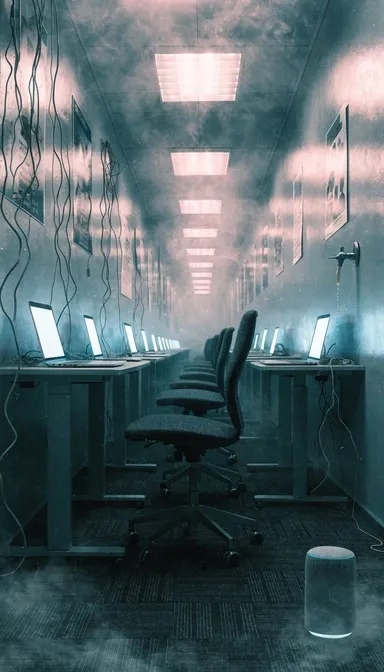
Photo: abandoned office computers startup graveyard empty desk, via images.stockcake.com
Somewhere in a decommissioned WeWork in SoMa, there is a Dell Optiplex that nobody ever properly wiped. Its wallpaper is still a motivational quote about disruption. Its taskbar still has Slack pinned to it. And its default browser — frozen in amber, untouched by the passage of time — is Internet Explorer 11.
This is not a horror story. Or rather, it is, but it's our kind of horror story.
Internet Explorer Tan has spent the better part of two months doing what our therapists would describe as "unnecessary archeological work": sifting through web archives, Wayback Machine snapshots, leaked internal wikis, and the LinkedIn profiles of former employees who definitely have opinions about this. Our mission? To document the final browser choices of defunct startups and failed tech companies — and to ask the question that nobody in the post-mortem reports ever bothered to include: was IE a symptom, or was it a cause?
The answer, as with most things involving Internet Explorer, is deeply unsatisfying and also kind of hilarious.
The Methodology (Such As It Is)
We want to be upfront: this investigation is roughly 40% rigorous and 60% vibes. Web archive data is patchy. Former developers are often bound by NDAs or simply too emotionally exhausted to discuss their final weeks at a company that burned through Series B funding building a "Spotify for salad."
But enough people talked. And enough Wayback Machine snapshots survived. What emerged was a pattern so consistent it bordered on cosmic comedy.
Of the 23 defunct startups we examined — companies that shuttered between 2020 and early 2024 — fourteen had measurable IE traffic in their final six months of operation. Not legacy traffic. Not bots. Actual human employees, using Internet Explorer, inside companies that were ostensibly building the future.
The Rankings: Most Embarrassing Final Browser Statistics
The Bronze Medal goes to a now-defunct HR tech startup out of Austin that, in its final quarter of operation, recorded 31% of its internal dashboard traffic coming from IE11. Their product was a "next-generation employee experience platform." Their employees experienced IE.
The Silver Medal belongs to a Chicago-based fintech that raised $47 million to modernize small business banking. Their own internal bookkeeping tool — the one their finance team used daily — was only certified for Internet Explorer. A former developer, speaking on condition of anonymity, told us: "We had a banner on our marketing site that said 'Built for the Modern Web.' I thought about that banner a lot during the layoffs."
The Gold Medal, and honestly it deserves a full trophy cabinet, goes to a San Francisco startup that was literally building a browser extension when it folded in 2023. Their GitHub repository, preserved forever in the amber of public version control, contains a comment dated four months before shutdown that reads: // TODO: test this in IE. Actually does anyone even have IE installed? Check with Dave.
Dave, for the record, did have IE installed. Dave was also the last person laid off.
"It Wasn't Hurting Anyone" — Famous Last Words
We tracked down three former developers willing to speak about their companies' IE situations on background. The conversations followed a remarkably similar arc.
First came denial. "It was just for one internal tool." Then rationalization. "The tool worked fine, nobody was complaining." Then, after a long pause, something approaching grief. "I mean, looking back, if we couldn't update an internal dashboard, what does that say about our technical debt overall?"
What it says, according to Marcus Chen, a frontend developer who survived two IE-adjacent startup collapses and now works at a company that has explicitly banned the phrase "we'll fix it later," is plenty.
"IE compatibility isn't just a browser problem," he told us over a video call where he appeared to be sitting in a room with nothing on the walls, which felt appropriate. "It's a proxy for every other decision you've been deferring. The moment you find out a company is still running IE internally, you start asking what else they haven't updated. The answer is usually: everything."
Symptom vs. Cause: The Verdict
Here is where we have to be honest with you, reader, because we respect you and also because we already used our good metaphors earlier in this piece.
Internet Explorer did not kill these companies. Bad unit economics, a 2022 funding environment that turned hostile overnight, and in at least two cases some genuinely questionable decisions about office space in downtown Manhattan — these things killed these companies.
But IE's presence in a company's final browser statistics is, we would argue, a leading indicator of a particular organizational pathology: the belief that technical debt is someone else's future problem. The conviction that "working" and "good" are the same thing. The quiet institutional tolerance for friction that, compounded over time, makes everything just slightly harder than it needs to be.
Sound familiar? It should. We've been writing about this browser for years.
A Note on the Dell Optiplex
We don't actually know if that laptop is still sitting in the decommissioned WeWork. The WeWork itself has probably been converted into something else by now — luxury apartments, or another WeWork, or a Sweetgreen.
But somewhere, in some office that used to believe in disruption, there is a machine that still loads the web in a particular way. Slowly. Incompletely. With a certain stubborn confidence that the rest of the world will eventually catch up.
We feel, in a way we find difficult to fully articulate, that this is a fitting memorial.
Rest in load times, everyone.